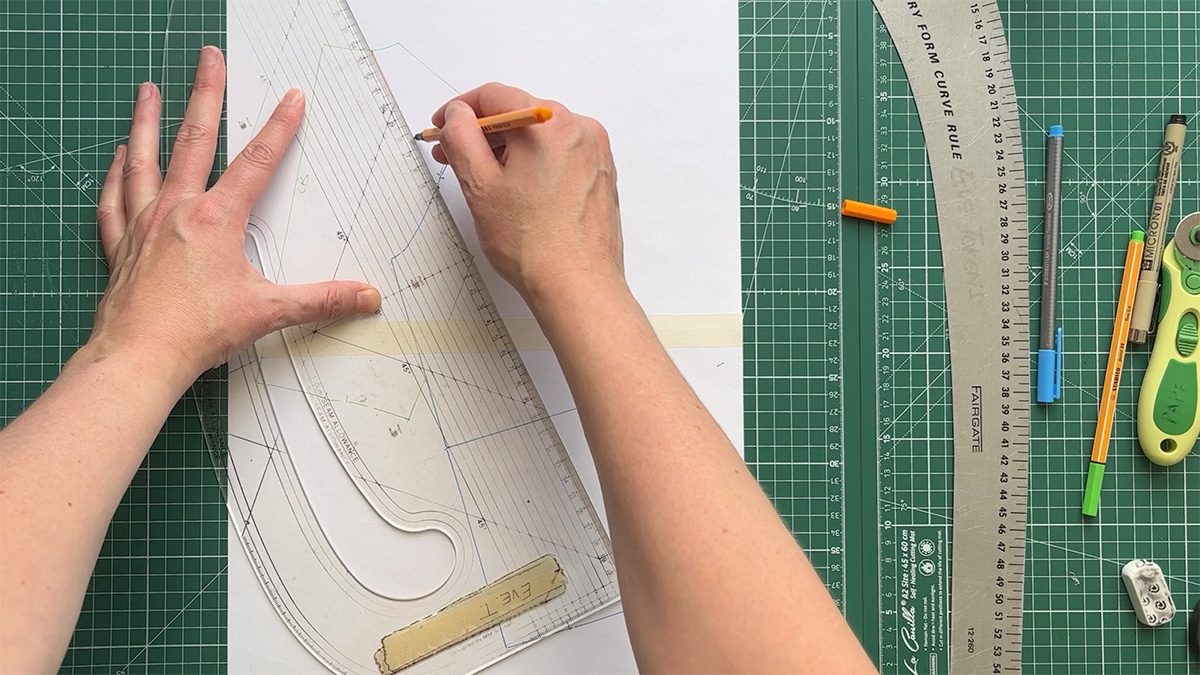
Pattern Making: How To Start Making Your Own Patterns
Pattern making is a fun activity for anyone who likes to make their own clothes, but it can be daunting to start with if you’ve never learned about the pattern making process before.
This article is more of a pattern making for beginners guide, to help sewing lovers better understand the methods of pattern making, and to be inspired to start learning the skills for themselves!
Later on in the article I’ve rounded up the various pattern making tutorials that I have created so that you can get started with your learning for free.
Note: Some of the links in this post are affiliate links, which means I may receive a commission if you make a purchase at no further cost to you.
Pattern Making Isn’t As Hard As You Think!
While for some people pattern making will feel hard, for others it will feel like a walk in the part. Yes it’s quite a technical skill, but anyone can learn it.
You’ll need to be ok with numbers – either in your head, on paper or using a calculator – because making patterns includes a bit of math, but I promise you it is a skill that is learned!
The Five Methods Of Pattern Making
There are five methods for making your own patterns:
- Pattern drafting with measurements
- Clone existing clothes from your closet by tracing them
- Deconstructing ready made clothes
- Developing a block from a commercial sewing pattern
- Draping on the stand
You can learn more about the ways to make your own sewing patterns here.
If you’re interested in learning draping, I have an online draping course for beginners that you can join anytime!
And for anyone who really needs their hand held, I do have my Creative Dressmaking membership which is most pattern hacking existing sewing patterns or blocks/slopers. This blog post explains more about it.
2D Pattern Making vs Flat Pattern Making
2D pattern making is a technique that is also known as flat pattern making, so without the use of a dress form or draping.
When you take a basic block and develop it into a pattern, you’re actively 2D pattern making! It’s become the go to method for garments that are not form fitting, such as jersey/knitwear pieces or less tailored dresses, skirts and shirts.
Working Patterns
A working pattern is one that is used to create clothes. There are four stages of creating a pattern:
- Line drawing
- Development pattern
- Working pattern
- Production pattern
Line drawing
This is a simple line drawing of a garment design, and is the often the starting point for a creative pattern cutter when developing a pattern.
If you’re making your own clothes patterns, then you’ll make a sketch and this will act as your line drawing. You’ll also use your line drawing to decide which block to start with.
Development Pattern
This is a pattern that stays intact, so that you can refer back to it. You’ll include style lines, pivoting, transfers, flaring, goddess etc!
I like to add dates to my development patterns so that I can easily go back if there’s an error later on.
Working Pattern
This is the finalised version of your development pattern, and you trace this off to create your production pattern.
Production Pattern
This is the pattern which includes seam allowance and is ready for production!
The production pattern that you create as part of the pattern making process should include:
- Grainlines
- Notches
- Balance points
- CF and CB info
- Design name
- Design code
- Size
- Number of pieces to be cut
Creative Pattern Making
Creative pattern making is the technique of developing both flat patterns and draped patterns in a more creative way.
Rather than following step by step instructions, a creative pattern cutter will experiment with a combination of flat pattern cutting and draping to create a unique and creative pattern.
This is my favorite way to create a new pattern!
How To Make A Pattern From Scratch
To make a sewing pattern from scratch you have several options.
1. Pattern Drafting
You can learn how to draft patterns using measurements. This is a great way to understand the basics, and by using your measurements you get a block/sloper that is closer to your body than a commercial pattern!
2. Pattern Development
You can also use a commercial clothing pattern and develop it to fit the vision you have. I teach this method inside my Creative Dressmaking membership!
3. Tracing Your Clothes

Finally, you can create a pattern from scratch by tracing existing clothes. It’s also known as ‘cloning’ and some people frown upon this but if you’re doing this for personal use only, I see no issue with it. In fact, this is a favourite method for both home sewers and fashion designers!
If making your own sewing patterns sounds like fun, you should check out my online pattern making course!
The Best Software For Pattern Making
If you’re keen to use a digital device to make sewing patterns, then there are a few to choose from. I personally use Adobe Illustrator to make my sewing patterns, but there are many that you can use. Here are just a few:
- Valentina
- Affinity Designer: now owned by Canva and free to use
- Adobe Illustrator: a recurring paid subscription
- Clo: a software that a friend uses, but I have no experience with at present.
I’ll be covering full reviews for each in due course!
Pattern Making Essentials
Let’s start with some of the essentials! These articles and tutorials are perfect for anyone completely new to making your own patterns, and will help you put together a pattern cutting toolkit, understand the different ways to make patterns as well as the various pattern symbols and more!
If you’re not completely new to pattern making, scroll down for my more advanced tutorials!
Pattern Making Tools

There are many tools available for pattern making – and I’ve covered many in my pattern making tools article – but here are several articles that are specific to individual tools so that you can better learn who they work and how to use them:
- How to use a tracing wheel
- French curve rulers for pattern making
- Measuring tools for patternmaking and sewing
Understanding Sewing Patterns

In order to make your own patterns you first need to understand them. These articles will help:
- How to read sewing patterns
- How to print patterns
- How to assemble patterns
- How to add seam allowance to a pattern
- What is pattern ease
- How to true a pattern
Drafting Basic Blocks & Slopers

Pattern drafting is the process of taking measurements and creating blocks from them. these could be your basic bodice block (mine is in the image above) or they can be drafted with additional ease such as a jacket block. Here are some of the pattern drafting tutorials available to you:
- How to draft a female bodice block
- How to draft a straight skirt pattern
- How to draft the straight pant pattern
- How to draft a pant pattern: detailed method
- Drafting a basic sleeve block
- How to use a commercial clothing pattern to make a block / sloper
Dart Manipulation Techniques

Darts are an integral way of suppressing fabric, and learning how to manipulate darts is an important skill. These articles will help:
Beginner / Intermediate Pattern Making Tutorials
Now that you have your basic blocks and an understanding of dart manipulation you’re ready to move onto more beginner / intermediate pattern making tutorials.
Making Skirt Patterns
You should have drafted a straight skirt block from the tutorial further up but you can also draft a full circle skirt pattern using your measurements too!
Sleeve Pattern Making Tutorials

Sleeves can be a great way to modify an existing pattern and make it more unique. As well as the basic straight sleeve block / sloper mentioned further up, these sleeve pattern making tutorials will help you be a little more creative with your sleeves:
Collar Pattern Making Tutorials

As well as sleeves, adding new collars can also work well to change up an existing sewing pattern. These collar pattern making tutorials will help you do just that:
- How to draft a mandarin collar pattern
- How to draft a Peter Pan collar pattern
- How to make a sailor collar pattern
If you want more guidance with pattern making, do check out my Creative Dressmaking membership here!
And if you’d like to see more advanced pattern making tutorials, let me know in the comments below!


Interesting post. Like to see where this is going to.
Thanks Sonja! Glad you enjoyed it! 🙂
Where are you located ? Julie mercer California
Hi Julie! I am usually located between the UK and The Netherlands! 🙂
I’ve just signed up for a pattern course at our local night school, so excited about this. Am hoping it’ll give me a better understanding of fitting and possibly altering garments. Have purchased material to make a jacket when I’ve completed the course so exciting times ahead for me.
Fantastic Janet – this sounds like lots of fun to me! Be sure to share your thoughts on the course and photos of your jacket – I look, forward to hearing more! 🙂
A very interesting Eve!
Glad it was enjoyable for you Delene. Let me know if you’d like to see anything else on the site! Best, Eve
Lovely but as a complete newbie I need pictures…. Thanks for your hard work.
Thanks for your feedback Eve! I am indeed working on creating visuals (photos and illustrations) but it does take time I’m afraid. I hope you have been able to enjoy the tutorials that do already have pictures. Best, Eve
Would love to be a pattern tester. Have a certificate in fashion n design and have got back into sewing madly and changing patterns lol. If you need someone else to sew your patterns as a tester I would love to. Ruth
You’ve rekindled my interest in pattern cutting and design. I so much agree with you about the difference between handmade and homemade, and always strive to create beautiful garments. I’ve just bought 3metres of beautiful soft draping wool fabric for£4 in a charity shop and am dreaming what I will create with it. I was there hunting for cotton shirts for my patchwork. I’d be interested in making up your patterns Eve.
My name is Ella Avery and I would like to know how much do you charge to make a pattern also can you make a pattern just by looking at the pictures ?
What software is being used? After you design you then need to write instructions? How do you get the images for the instructions?
How do I get tutorials
Hi – i’m trying to find out how to position pattern pieces into fabric – so that they drape properly. Can you help please?
Grt one here. But plz which pattern making book can you recommend for a beginner. Lol, im a total novice yet i love to know about making perfect pattern
Hello, I’m Zoe from Australia “the Land Down Under” lol. Hello to Everyone else, it’s so nice to see you all 🙂
Welcome Zoe! How’s life down under?
thank you, mam, very useful to beginner
Besic parrtens making for only ladies
This is because I specialise in womenswear. I try not to teach on topics I have limited knowledge on!
Im so glad to have done a pattern making search thanks so much
Ah, thank you Julie for finding your way and enjoying the pattern making tutorials! Do let me know if there’s something specific you’d like to see, I can always add it to my pattern making tutorials list!
My goodness!!! I discovered a treasure trove….now I have to discover where I can squeeze more time out of the 24 hours regularly delivered to me.
I am so excited to begin this journey…I will keep you posted.
Oh Angelita! What a wonderful comment to find when I logged into my website – thank you so much! And if it makes you feel better, my Dad frequently says to me that I need 48 hours in a day to get all my plans completed!
Thank you so much Eve for helping others with their sewing projects, it’s so good of you and I would love to learn from you as I am fairly new to sewing and I am interested in creating my own clothes. I hope I am able to develop it.
Thank you for this I need more advanced pattern
Thanks,Why not posted more pattern making video,which will be more helpful
I already have some pattern making videos on my YouTube channel… and I also have a membership where I’ll be adding pattern making content too. I just cannot justify making all of it for free – got bills to pay!