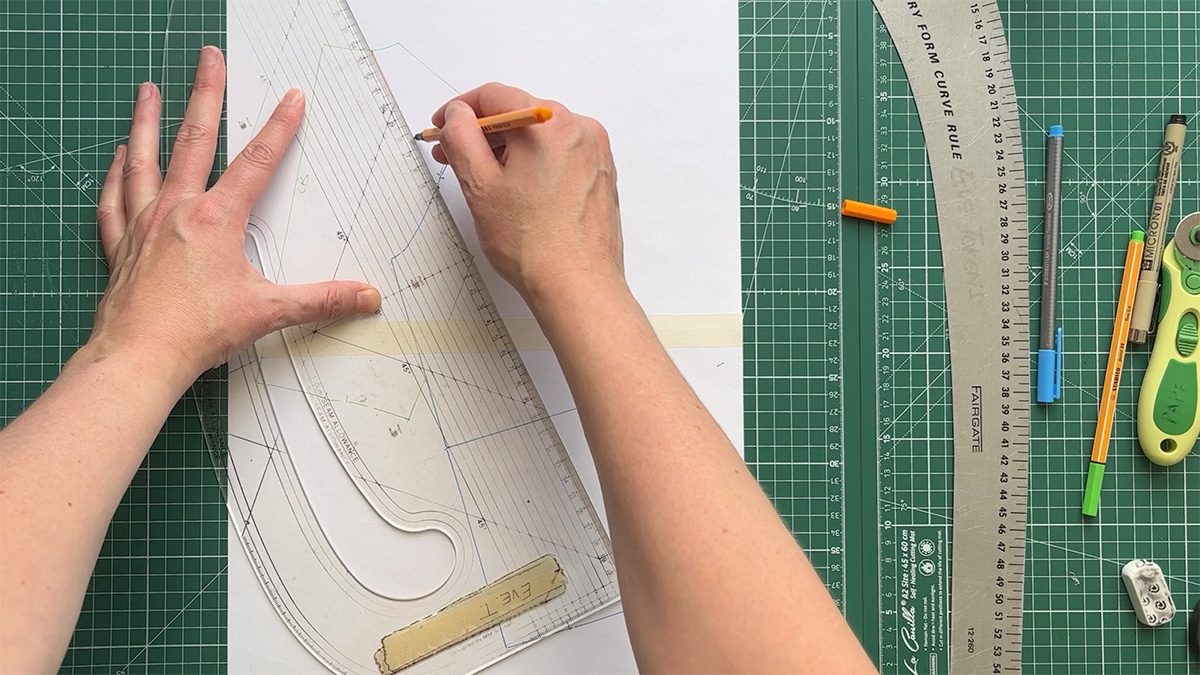
5 Ways To Make Your Own Sewing Patterns!
As more people become disillusioned with fashion, they start to look into making their own clothes, whether for more personal reasons like fit or because they want to know that the end garment is ethically made.
This means that more people are searing for information about the different ways that sewing patterns are made – which suggests that many of you reading this are eager to learn how to make a sewing pattern of your own!
It isn’t the easiest skill to learn, but there are pattern making tricks and tips that will help anyone willing to give it a try.
Today, I’m going to share with you the five methods you can use to make your own sewing patterns. And I’m not talking about digital sewing patterns, but the sewing patterns you create for yourself, so that you can make your own creative and amazing clothes. Which is kind of epic right?
The first thing to consider is which technique you should use to make your own clothes patterns.
Before you can know this, you need to:
- Have an idea of the technique you like to use the most – this is because most people have different ways of learning and working.
- Be aware of the time you have available – some methods are faster than others.
- Know what design you’ll be working towards making, so that you can be in the best place to get it right first time.
Some of the links in this article are affiliate links. This means that I may receive a fee at no extra cost to you if you purchase a recommended product.

5 Techniques To Make Your Own Sewing Patterns
Most people decide to come and learn pattern making because they are fed up needing to make multiple modifications to commercial patterns for a better fit.
From a full bust adjustment, a sway back adjustment and then a length adjustment too… and you could spend all day altering a sewing pattern and ending up nowhere closer to an actual finished sewn garment, and with a pattern that looks nothing like the original pattern designer intended!
Then there are those people who want more creative wardrobe options than what the shops allow for. And I get it…
As someone that has mostly been the tallest – in the room, in my school, at work, in life – finding clothes that fit me lengthways has always been a struggle.
Yet what are the methods that you can use to create your own patterns, and how do you decide which one is best at the time?
There really are only five techniques that you can choose from when you want to make your own sewing patterns:
- Drafting from scratch using your own body measurements / measurement guide (Pattern Making Basics can help with that!)
- Trace an existing item of clothing that fits well, which is really cloning your favourite clothes!
- Deconstruct an existing item of clothing that fits well, and make a pattern from it
- Modify a well fitting commercial sewing pattern
- Draping 3D to create a 2 dimensional pattern
Method 1: Drafting Sewing Patterns From Scratch

This is the one people go for when they are new to pattern making. They decide they’re going to dive right into pattern drafting when making their own sewing patterns, and they buy a pattern making book which they struggle to understand, because… the reality is that the included diagrams aren’t often self-explanatory!
Then when they ‘have a go’ at drafting a block from the book they get it wrong and often end up disheartened and give up. Does this sound like you?
To be fair, the reason for this is often because the inaccuracy of their measuring or undisclosed erratum in the book!
When drafting sewing patterns from scratch, your measurements need to be taken:
- At the right locations
- By somebody else
Inaccurate or incorrect measurements used to draft a pattern block or sloper will result in a pattern, block and sloper that is ill-fitting and wrong.
While drafting from scratch isn’t a necessary skill to learn for future pattern making success, I do feel that going through the process really helps you to understand how a pattern is created.
There are two ways to draft from scratch.
- Use a set of measurements provided in a book for the size closest to you, and then modify the block to better fit your personal measurements.
- Use your own measurements to create a block or sloper from scratch.
Method one is best for getting an accurate base pattern and then applying the solutions to various fit problems that you have to the pattern.
Method two is best for those who feel very confident in their measuring skills and can jump straight in.
If you’re keen to start drafting, these three pattern drafting tutorials will get you started:
- How to make a simple skirt pattern
- How to draft a female bodice block
- How to draft a simple trouser block
- How to draft a circle skirt pattern
Method 2: Tracing Existing Garments Into Sewing Patterns

This technique is used in the fashion industry ALL THE TIME!
You start by finding a garment that you like that fits well, and then create a pattern by tracing around the different sections. True up the different sections to make sure that when they’re sewn together, they fit together perfectly.
And when the fit is good, you develop other styles from it.
Learn more on creating a pattern from a woven garment here or learn about tracing a knit garment.
The reason this technique works so well is that it is usually a garment that you love and know fits well. And you are replicating it, which means when clones into a new sewing pattern, if done well, it should also fit well once any minor inaccuracies are smoother out.
That said, the tracing technique is not always the most accurate method for making sewing patterns. Think about those knitted tees you have and how when you wash and hang them you notice they have twisted side seams? This comes through when tracing knitted garments, so you really need to know what you’re doing in order to do it right.
To help with that, you should have a look at my friend Claire-Louise Hardie’s book Clone Your Clothes! She walks you through a variety of processes to help you recreate your favorite clothes!
Method 3: Deconstructing An Existing Item Of Clothing

My preferred ‘hacking’ method – over tracing anyway – is to deconstruct an existing item of clothing. I find that this results a more accurate sewing pattern than the tracing method of cloning the garment.
Using one or more garments that fit perfectly, is a great way to get that personal ‘moulage’.
I recommend starting with something that you love the fit of, but no longer wear because of the colour. You won’t feel any pangs of regret then when you carefully deconstruct it to make your own sewing pattern from it!
I am slowly creating a PDF workbook that walks you through the lengthy process step by step to get the best possible results. It should be available soon.
The down side to this technique is the amount of time involved. As you are meticulously deconstructing a garment – and all its many sections! – you should also be properly documenting the construction / deconstruction process so that you can recreate it when the sewing pattern is finished. And this takes time.
Method 4: Modifying An Existing (And Well Fitting) Commercial Pattern

If you fall into the category of learning how to make sewing patterns for use by other people – i.e. you will be making money from the patterns – you cannot use a commercial sewing pattern as a base. You’d be stealing someone else’s intellectual property for profit which is not cool or legal.
But, if you are a general sewing person, only interested in making your own sewing patterns for yourself, then definitely learn how to develop a commercial pattern into a block for your own personal use.
Make sure that you note down the ‘origin’ information on any patterns you then go on to create, for transparency’s sake later on.
The bonuses of making sewing patterns from existing commercial patterns is that it takes less time to get the base pattern than any of the previous methods.
For me though, I prefer to use commercial / indie sewing patterns as intended, and develop my own sewing patterns for myself.
If you are keen to try this method of creating patterns, but feel stuck, check out my Creative Dressmaking membership. It’s where I teach my members how to take an existing pattern in their stash to develop it into something new and unique to them.
The first project we tackled is the classic (or not) shirt, and you can see my beginning steps in my post about how to design your own shirt.
Method 5: Draping To Create A Two Dimensional Sewing Pattern

If all else fails, one of my favourite techniques is draping.
And let me just be clear – this is far and away my favourite method of making my own patterns!
When I was a first year fashion design student, I ended up helping a final year student create his patterns for his final collection, from his draped and contoured designs. Actually, I didn’t help him, I DID them.
Othonas was clueless when it came to creating patterns. He could drape beautifully, but getting the draped design off the stand or model, and onto paper as a reusable pattern? He had no idea! And yet it came easily to me.
Taking a piece of cloth and draping on the stand, or on a model – and then taking the pattern! – is just A WHOLE LOT OF FUN! 🙂
Draping to create blocks is possibly the most accurate of methods. You really are creating a moulage of yourself. Except.. it’s awful tricky to drape on your own body right?
For that reason, people usually take in person classes, team up with a sewing buddy to work on each other, or use the tee shirt / duct tape method of creating their own body double.
You will need a dress stand or a human as a model, but it is definitely one of the more fun and creative methods of making your own sewing patterns!
To get started draping your own patterns, read my guide on the best dress forms for women who sew – you’ll need a dress form to start draping! – and then register for my Drape & Contour for beginners class to learn the basics!
Pattern Drafting Tutorials
If that’s whetted your appetite and you’re ready to start making your own sewing patterns, here are some helpful, nifty and free pattern making tutorials for you to get started with:
- Draft a female bodice block
- Make a simple skirt pattern
- Full circle skirt pattern
- Mandarin collar pattern
- Tracing woven clothes into patterns
- How to draft a sailor collar pattern
I hope that this has inspired you top create your own patterns using the different methods. If you have any questions about the five pattern making methods talked about here, please do feel free to drop them in the comments below.


Would like to learn how to draft patterns. Like i can just look at a garment and know how to make it.
Yes I would like to learn how to draft and drape a pattern.
I really want to learn from pattern making to cutting to final garment.
Best video to teach making your own clothing patterns
I really want to make my own patterns
Excellent! I have lots of free pattern drafting tutorials here on the blog, so do check those out to start with!
What do you think about online sewing pattern designers? I am going to try out Sewist
Hi Nancy! Sorry, I only just saw this comment buried low down. Personally, I have never tried them. Pattern making is my absolute passion, so I’ve never seen the sense in creating a pattern in with an online tool myself. But, you have raised a consideration that it would be a good idea for me to test out the accuracy so that I can help my readers with questions on them. Thank you – and do let me know if you try out Sexist and how you get on with it! Xx
unfortunately all your methods rely on you having either a dress form your size , a pattern that fits or a garment that fits . when you are 2 sizes bigger in the bust than the hips and only 45cm tall ,and slender this is a non event. the nearest pattern that came close to fitting was a 9JP(junior petite Simplicity which are no longer being made apparently small thin ladies are not being catered for as they think you can wear childrens . but the bust hip ratio is way out of line. and as for styles .my teenage granddaughter wouldn’t wear them
Hi Karyn. I’m sorry to hear that you’ve had such a struggle. And I appreciate that there is not very much in the way of help from clothing brands of pattern companies for those who did not fit their idea of ‘normal’.
I do have methods for drafting your own patterns on my website, based upon your personal measurements, which have been very helpful to many who try. All that is needed is a measuring tape, a calculator, a ruler, paper and pencil, and a little patience. So I would encourage you to have a go.
Can I just check; in terms of height, did you mean to write 45cm?