
Making My First Wedding Corset Toile
If you didn’t catch my first vlog of the series, I’m making my own wedding ‘gown’ for our wedding in August 2026, and the first stage is to get comfy with corsets.
I know there’s a lot of hoo-ha about wearing corsets, but I have very fond memories of wearing corsets in my younger years when I lived in NYC, back in 2003. I had a French crop hairstyle dyed the darkest of blacks and I used to wear the corset with a multi layered black tulle skirt and the most gorgeous boots.
My fiancé often says that he’s sad that he didn’t know me back then, so I thought I’d add a little bit of what made me who I am today into my wedding outfit – hence the corset and skirt combination I’m working towards.
The first stage is to get comfortable with a corset that fits. My first toile is made from the Oxford School of Corsetry pattern available on their Patreon. I think I refer to it as the ‘Sew Curvy’ corset in my first vlog, because I feel like that is what the brand was before…
Anyhow, let me take you behind the scenes of creating this first toile! It was a multi-day effort, and so I’ll break down each toile process as much as I can!
Cutting The First Corset Toile

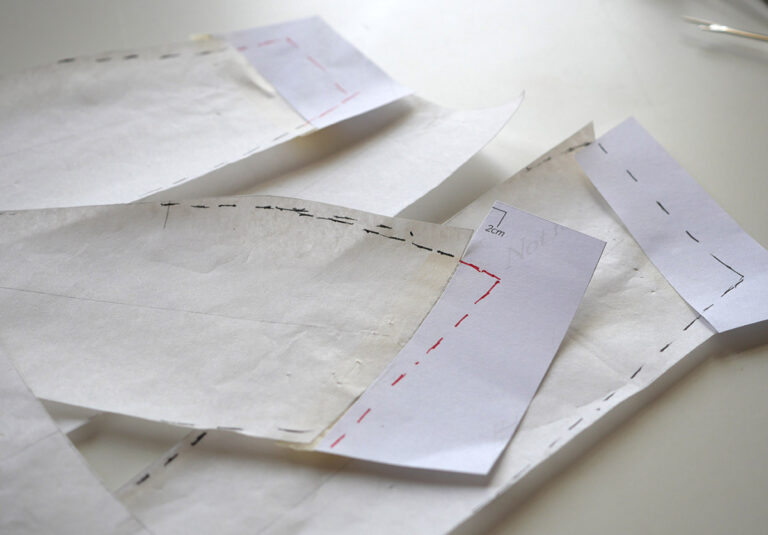
I cut the pattern – six for the front, six for the back, totaling twelve pieces in all – from a previous toile for a pair of woven joggers. There was some existing marking on the fabric, but for the most part, it was very good condition and pre-washed.
I cut all the pattern pieces on the straight grain and drew 1cm seam allowance around the side and top of each piece, leaving an extra 3-5cm at the hem, as I wasn’t sure how much length I would need.
I also marked in all the waistline notches, numbered each piece and then for good measure I added in dashed lines for the lengthen/shorten lines shown on the pattern pieces.
Sewing The Corset Toile Together

My next task was to sew all the seams together. I do not have the instructions for this pattern as I am no longer in the Patreon, and only saved the PDF pattern when I joined, so it was a ‘make it up as I go’ situation.
As such, I completely forgot that I needed to prepare fabric to add a busk at the center front. So, I have a center front seam instead. Oops.
I also did not include or think about the fastening method. Typically, corsets are closed at the back with lacing through eyelets. This was again something I didn’t consider.
I’m putting it down to eagerness of actually starting this mighty project, because I also forgot to take my up-to-date measurements and cross check them against the pattern.
I did press the seams carefully though, ready for the corset bones!
Choosing The Type of Corset Boning

I have a variety of corset boning in my collection because I have been preparing for this wedding project for a while now.
The options available for the toile included:
- Rigilene boning: this is also known as featherlite, it is super flexible and can be sewn directly to the fabric.
- Plastic cased boning: this is plastic boning – similar to industrial zip ties – encased in fabric and sold on a roll. It also comes in different widths.
- Flat steel boning: the strongest option, but it is flat, requires tools to cut and a bit OTT at this stage.
- Spiral steel boning: not as strong as flat steel, spiral steel allows more flexible movement.
I ended up going with the encased plastic boning as I did want to have enough support to keep the girls in place. Wink.
I cut a piece for every seam, including two for the center front. They were very curled, so I gave them a good press with my iron and then used my wooden clapper to make sure that they cooled flat.
Attaching The Boning Casing
Next up, I removed all the bones from their casings and then carefully pinned every casing into position over the existing seams of the calico toile. It took about an hour to do this, but I took it slow and methodical so that sewing them in place would be a breeze.
At the sewing machine, I used a 4mm stitch length – so that if I have to, I can more easily remove the casings – to stitch the casings in place. I sewed each one in the same direction, from the top to the bottom, and closed off each bottom edge too.
Smoothing The Corset Bones
I initially thought I’d go the route of wrapping the tips in masking tape to protect the fabric from the sharp edges, but this just made them bulky and unsightly.
My next thought was a Dremel to smooth the edges, but as I still don’t have one here, the only thing I had to hand were my Mum’s old nail files, which I never use. They did the job, though it was dusty and slow work.


Once they were all smoothed, I inserted them into their casings from the top down.
Attaching The Waist Tape
It was about this point that I remembered I hadn’t added in the waist tape. Argh!
The waist tape is a piece of grosgrain that is woven so tight that it doesn’t stretch out. It is added at the waistline of all seam allowances to help keep the corset in place, so it doesn’t ride up or slip down.
I pinned mine either side of each boning channel, and then sewed securely in place.


Fastening The Corset
Before I could try my first corset toile on, I needed to add some type of fastening.
The sensible option would have been to install an open-ended zipper to make it quick and easy, but that is not my go to in life so I made a base eyelet piece that I could attach and detach each time.
Creating The Reusable Eyelet Piece
Creating the eyelet panel for the back was a testing process. I created a pattern piece based on the original back piece from the corset pattern and marked in where the 5mm eyelets would go.
Sewing the piece together was simple, but I forgot to cut two pairs. I did remember to sew in the channels for the boning that would go either side of the eyelets for additional support.
Installing The Eyelets
Then came the hard part – installing eyelets. I have a great hand press from Italy, but I have never been able to source the pieces for eyelets that are smaller. So, I resorted to my Prym Creative tool.
This was a failure from the start. The eyelets were gold 5mm eyelets from the shop … and using the original Prym tools for setting 5mm eyelets resulting in damaged fabric and an irrevocably crushed eyelet.
I ripped it out, watched a YouTube tutorial and tried again. Another fail.
As it was 1030pm and I wanted it to be over, I found out the Italian hand press and the larger grommets that you will have seen in my clothes fastening types post and installed them down the original line. I couldn’t put them spaced so close together due to the increase in their diameter, so I spaced them two holes apart, but it worked. Then I had to remove the stitch line for the one boning channel that was still viable and resewed it.
The following morning – when my brain was able to properly think – I found out the 5mm gold eyelets and tested various methods of insertion on scrap fabric pieces.

The first example, I used the awl to make space for the eyelet post and then installed the eyelet. It was not successful, with the post splitting in a very unsightly manner. It would certainly rip any ribbon threaded through to shreds.


So, I took out the piercing tools that came with the Prym Creative tool and tried again.
I started with the 3.5mm hole and the 5mm rivet adapter. This was only slightly better than the first attempt.


Next up, I decreased the size of the hole to 2.5mm and then used the 4mm eyelet adapter. This was the best version so far.


To double check I had installed the ‘cover’ part of the eyelet correctly, I tried one more time, placing it the reverse (wrong side) up, and the result was better than the 5mm adapter, but worse than the previous attempt.


I suspect the real culprit is not in how I’m using the Prym tool, but in the eyelets that I’m using. I wanted to use what I already had in my stash, but judging by how damaged the lower plastic bit is becoming, I suspect I may need to spend more cash on the dedicated Prym eyelets.
I hate being tied into one brand in that way, as you are held to their ever-increasing costs, but this is what it is. Sigh.
The Final Eyelet Piece
As I couldn’t fit the corset toile until the eyelet piece was created and installed, I sewed the second side and installed the large grommets to match the first piece I had sewn. I made sure to use the awl to make a hole big enough for these larger grommets to fit into.

They are gunmetal in color, and not at all pretty to look at, but they do the job, and I was then able to try on the corset toile and note possible fit issues and pattern changes.


Here’s a close up photo of one of the finished eyelet pieces. Ignore the small holes in between each grommet, this is where I would have installed smaller eyelets.

And then of course I needed to add the ribbon. I forgot to bunny ear it, because I was rushing for a meeting, but the ribbon I used was effective for a fit test.

The First Corset Toile Fit Test
I always knew it would be a risky thing, making a toile from a pattern that I measured myself for 18 months previously.
Bearing in mind that I didn’t measure before cutting and sewing… I don’t think it’s a bad starting point. Here are two photos of me trying it on.
Corset Toile Front

Corset Toile Side

Corset Toile Back

To begin with we can see that the front of the corset toile is too long. I suspected it would be… it is also gaping a lot away from the top of my bust, visible in the side view photo.
Finally, we can see from the back view photo that the corset in general needs to be smaller going around the body – there is no gap at the top, and the bottom was easily pulled together, it’s just separated because I didn’t tie a bow.
This first corset toile will provide me with no reduction at the waist, which is the something I do want from a corset, along with support for the girls. The waist tape helped the corset toile to sit in the right position, and it was very comfortable.
The Next Corset Toile
Wearing a corset takes some getting used to, so I am okay with putting in the effort now to find what works for my older, curvier body.
So, with all that, I’m going back to the drawing board. My first love is pattern drafting, so it makes sense to draft a few corset patterns myself to see if I can land on one that really works for me.
My three plans are:
- Draft a bridal corset from Corsets & Stays Vol.2.
- Drape a corset on my dress form.
- Use my existing close-fit bodice block to pattern a corset.

I’ll be sure to share the process on all three methods here on my blog but let me know in the comments if it’s something you’d watch on my YouTube channel too!
And this toile? Well – it won’t be going to waste.. I dragged out my favorite old pair of jeans I made for my 40th birthday and will be refashioning those into the most gorgeous textured denim corset. Below is a photo of their current condition, after five years of solid wear!

Stay tuned for an update on that soon!
And here is a final photo of me trying it on. I’ll cover the changes I’m making in my next post as this is wordy enough already.

I enjoyed the article,” making my first Wedding Corset Toile” and am interested to see the alterations that you make to the original. I would also like to see it on You Tube.
Always enjoy your blog, keep it up, Paul
Thank you so much! I had great fun making this first version and have written up the alterations ready for the next instalment! Enjoy your weekend!